
XSales® is advancing practical AI capabilities that help sales organizations improve field execution, strengthen decision-making, protect sensitive data, and control operating costs. This update highlights where AI can create value today, the strategic foundation required to scale responsibly, and the next mobile-first innovation on the roadmap.
Leadership takeaway: The opportunity is not AI for its own sake—it is faster execution, stronger customer service, better resource allocation, and measurable commercial impact.
AI That Improves Mobile Sales Execution
AI can turn everyday field activity into faster, more consistent, and more profitable execution.
Improve in-store visibility. Image recognition simplifies customer price audits, inventory counts, and planogram-compliance checks—reducing manual entry and giving management more timely field data.
Increase order quality. Predictive suggested orders combine historical sales, weather, regional events, and seasonal shifts to improve demand estimates and reduce both stockouts and excess inventory.
Protect margin and competitiveness. Dynamic pricing evaluates market trends, competitor pricing, and inventory age to support customer-specific pricing recommendations.
Lower field-service costs. Route optimization considers traffic, weather, and delivery windows to reduce travel time and fuel consumption.
Strengthen planning accountability. Quota assignment and achievement prediction use performance history, territory potential, seasonality, and pipeline health to support realistic targets and earlier intervention.
Grow revenue per customer. Smart cross-selling recommends priority products and new launches based on purchase history, while smart point-of-sale guidance recommends the most effective activities and execution sequence for each visit.
Two Strategic Pillars for Scalable AI
1. Comprehensive Strategy: Governance & Alignment
A coordinated enterprise approach eliminates silos, reduces technical debt, and accelerates return on investment.
- Central governance: A cross-functional steering committee evaluates, approves, and audits AI initiatives.
- Standard technology stack: Unified APIs, data pipelines, and integration frameworks reduce fragmentation and vendor lock-in.
- Value-based prioritization: Use cases are selected by balancing operational complexity with potential business value.
- Measurable success: Every deployment is tied to quantifiable KPIs such as time saved or revenue generated.
2. Private Models in the Cloud or on Mobile
A private-model strategy improves security, protects intellectual property, and makes costs more predictable.
- Data sovereignty: Proprietary information remains within corporate boundaries.
- No public-model training leakage: Enterprise prompts and inputs are excluded from public foundation-model training.
- Domain-specific accuracy: Smaller open-weights models trained on proprietary data can improve performance for targeted workflows.
- Cost control: Dedicated infrastructure or private cloud compute reduces exposure to volatile token-based pricing.
Product Innovation Update
Now Available: Customer Price Census with Shelf Image Recognition
The first image-recognition use case in XSales® SFA Mobile accelerates shelf-price capture. Users can analyze a new or existing photo, automatically populate the price-census form, and make corrections when needed.
Executive benefit: Less manual data entry, faster store execution, and more consistent pricing intelligence. The current capability requires internet access for photo analysis.
Coming Next: Suggested Orders Powered by Mobile NPUs
The next planned use case brings predictive demand estimation directly to mobile Neural Processing Units, enabling suggested-order generation on the device.
- Instant, offline execution: Field teams can generate orders in warehouses, basements, remote stores, and other low-connectivity environments.
- Stronger privacy: Sensitive retail and store-level transaction data remains on the device.
- Lower centralized compute costs: Device-based inference reduces reliance on cloud processing across a large mobile workforce.
What Leaders Should Do Now
- Prioritize high-value workflows where speed, data quality, or field productivity can be measured.
- Assign executive ownership and define governance before scaling pilots.
- Establish baseline KPIs for time saved, revenue impact, execution quality, and infrastructure cost.
- Prepare data and mobile deployment standards for secure private-model adoption.
Some screenshots samples

Image recognition
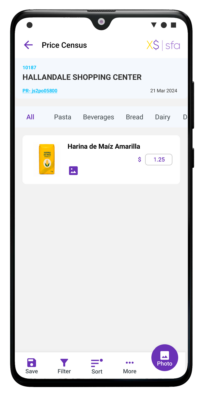
Capturing the product prices
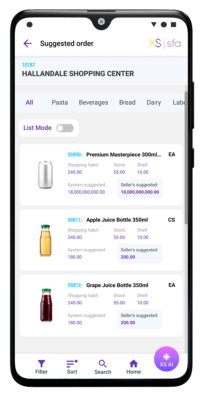
Suggested order using XSales® AI
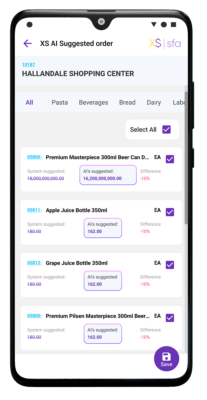
AI Suggested order